
Back on the Road, But Safer?
AAA Survey Finds Driving Habits Stabilizing Since Pandemic but Warns of Safety Issues for Older Cars
DEARBORN, Mich., (September 5, 2024) — The AAA Foundation for Traffic Safety released its 2023 American Driving Survey, providing insights into U.S. daily driving trends after the initial impact of the COVID-19 pandemic. The survey reveals that overall driving patterns have rebounded from the depths of the pandemic.
 |
Stable Driving Patterns:
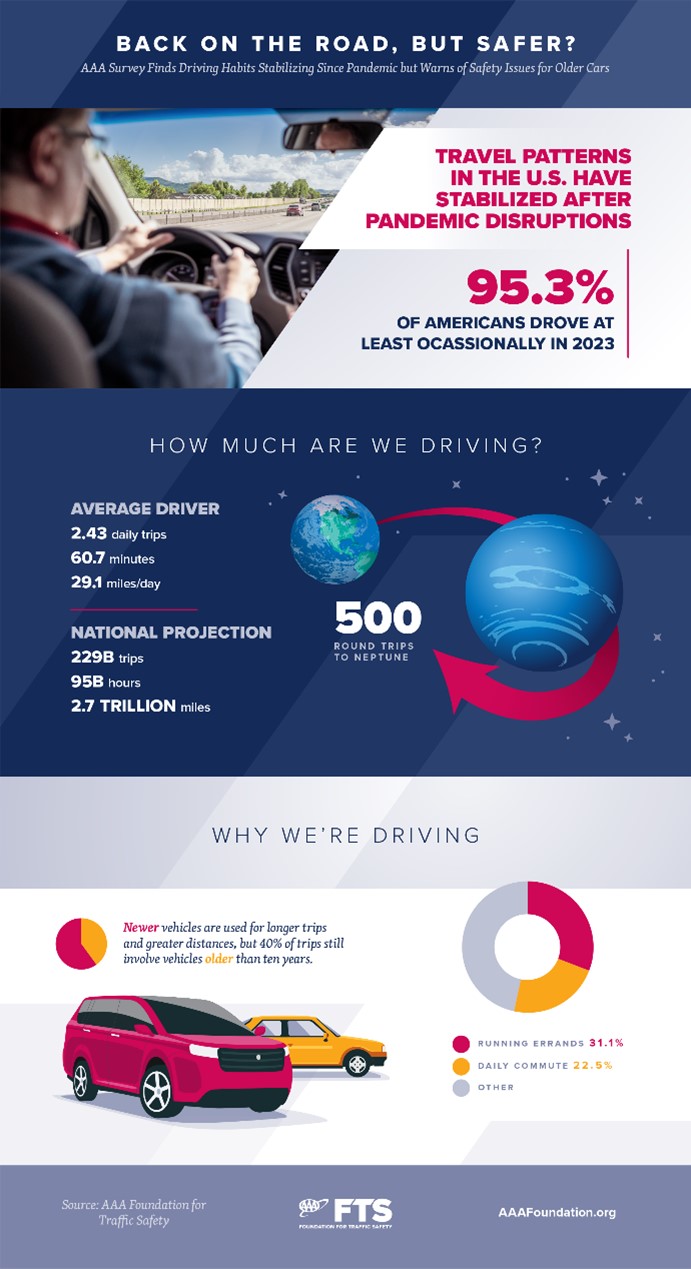
The percentage of Americans who drove at least occasionally remained steady at 95.3% compared to 2022. Driving trips averaged slightly less than 2.5 per day, with a duration of just over an hour and nearly 30 miles. These figures continue the trends observed in the past two years. Most driving trips in 2023 were undertaken to run errands (31.1%) while commuting to and from work comprised 22.5% of driving trips. Most trips began between either 11 am–2:59 pm (26.1%) or 3–6:59 pm (27.6%). Very few driving trips began between 3–6:59 am (6.7%) and 11 pm–2:59 am (4.5%).
Variations by Demographics:
The survey highlights some demographic differences. People living in metropolitan areas and those with higher education levels tend to drive newer vehicles. Conversely, teenagers and those with lower education are more likely to drive older vehicles. Several emerging driving patterns that appeared after the onset of the COVID-19 pandemic in 2020 continued in 2023. Drivers with a high school education or GED drove more miles than those with a bachelor’s degree. Hispanic/Latino drivers had the highest driving durations and miles compared to all other ethnic groups in 2023. Like pre-pandemic data, men spent substantially more time driving daily than women did in 2023.
Safety Concerns with Older Vehicles:
The increased use of newer vehicles for longer trips is positive as they typically come equipped with advanced safety features. However, the survey raises concerns as nearly 40% of trips involve vehicles older than ten years. These vehicles often lack modern safety features and may be in poorer mechanical condition, potentially contributing to a higher risk of crashes. Those living in the Midwest, West, and South were likelier to drive older vehicles than those in the Northeast. Teenagers and those with lower education are more likely to drive older vehicles. Additionally, respondents who were divorced or separated and those who were never married were more likely to drive older vehicles than those who were married.
About the AAA Foundation
Established in 1947 by AAA, the Foundation for Traffic Safety is a nonprofit, publicly funded 501(c)(3) charitable research and educational organization. The AAA Foundation’s mission is to prevent traffic deaths and injuries by researching their causes and by educating the public about strategies to prevent crashes and reduce injuries when they do occur. This research informs the development of educational materials for drivers, pedestrians, bicyclists, and other road users.
The Auto Club Group (ACG), named a 2026 Forbes Most Trusted Company in America, is the second-largest AAA club in North America, with more than 14 million members across 14 U.S. states and two U.S. territories. ACG and its affiliates provide members with roadside assistance, insurance products, financial services, travel offerings and more. ACG is part of the national AAA federation, which serves more than 66 million members across the United States and Canada. Its mission is to protect and advance freedom of mobility and improve traffic safety. Morning Consult recently ranked AAA Insurance as America's most trusted insurance brand for 2026, reflecting the confidence consumers place in the AAA brand. For more information, download the AAA Mobile app, visit AAA.com, and follow us on social media.